

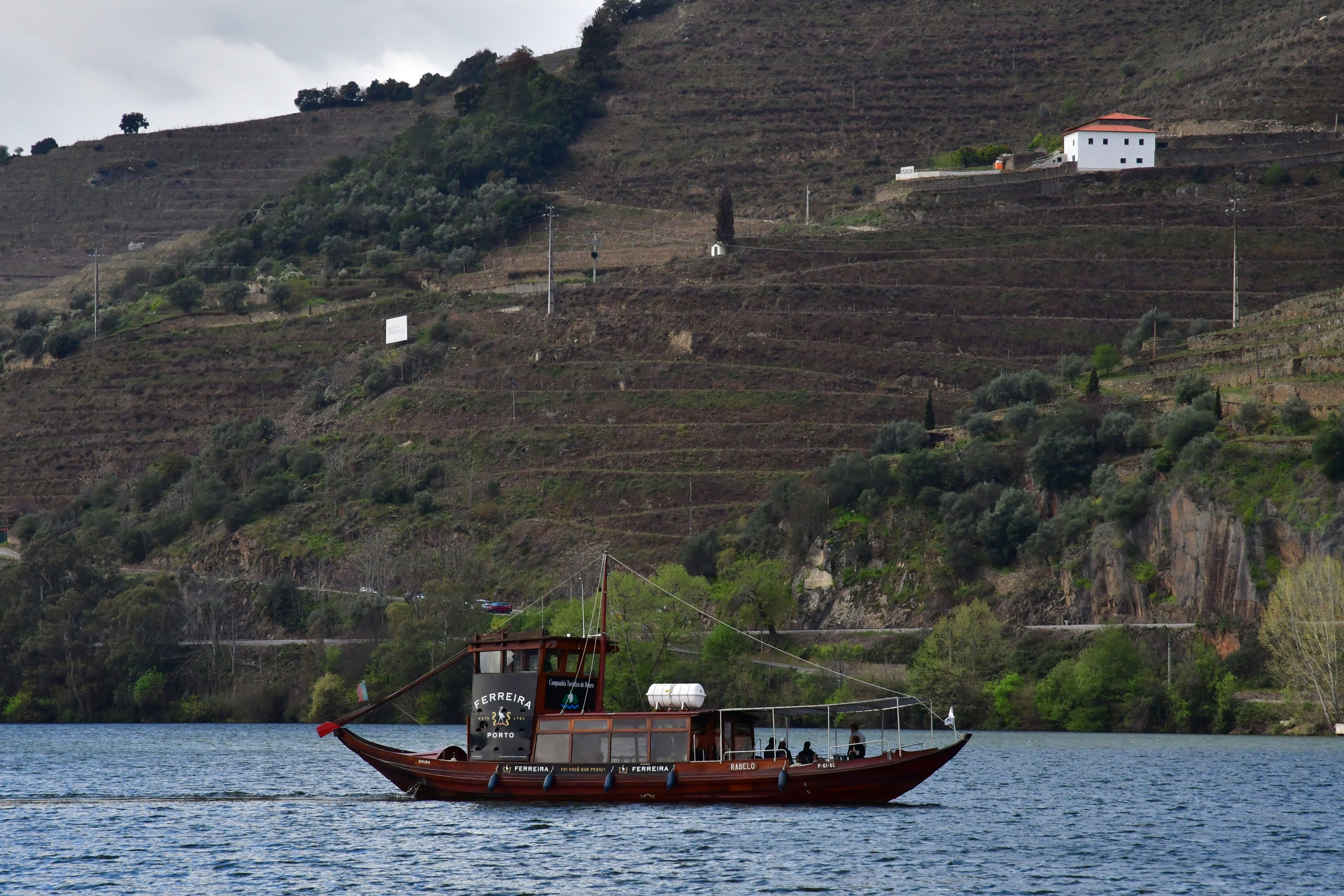
If you’re planning a trip to Portugal’s Douro Valley, there’s a moment you’re unlikely to forget: stepping aboard a traditional rabelo and drifting quietly along the Douro River, surrounded by terraced vineyards, hillside quintas, and one of the country’s most remarkable landscapes.
These wooden, flat-bottomed boats once carried barrels of Port wine downriver from the vineyards of the Douro to the wine lodges of Vila Nova de Gaia. Today, they carry something different—visitors eager to experience the river and the stories it has shaped for centuries.
From Pinhão, you can choose from short scenic cruises or longer excursions, each offering a river’s-eye view of the Alto Douro Wine Region and its extraordinary history.
After seeing the Douro River by train the previous autumn, Paul and I finally experienced it from the water on our first rabelo cruise.
The History of the Rabelo Boat.
The rabelo (sometimes spelled barco rabelo) is a vessel unique to the Douro River. No other place in the world used this specific design.
These boats were painstakingly engineered for the challenging river conditions:
A flat bottom and no keel allowed them to navigate shallow, fast-flowing stretches.
The name “rabelo” comes from the long steering oar (espádela) projecting from the stern, akin to a tail (“rabo”) used instead of a conventional rudder.
They typically ranged from 19 to 23 meters long and could carry 40 to 100 barrels of Port wine, crewed by six to twelve men.
Records place rabelo use as far back as the 13th century in local lore, but modern regulation appears around 1792, when the Companhia Geral da Agricultura das Vinhas do Alto Douro set formal rules for their capacity and navigation.
Because upstream navigation was difficult, boats were sometimes hauled by men or oxen along towpaths (caminhos de sirga) carved into the rocky banks.
The rise of rail transport in 1887 reduced the rabelo’s dominance for cargo, and with damming in the 20th century, their commercial role largely ended. Some of the last wine-carrying voyages occurred in the 1960s and early 1970s.
Today, rabelos live on in tourism, tradition, and regattas, most famously the São João Rabelo Boat Regatta held every June in Porto, celebrating the vessel that once defined the valley.
What a Rabelo Cruise from Pinhão Feels Like.
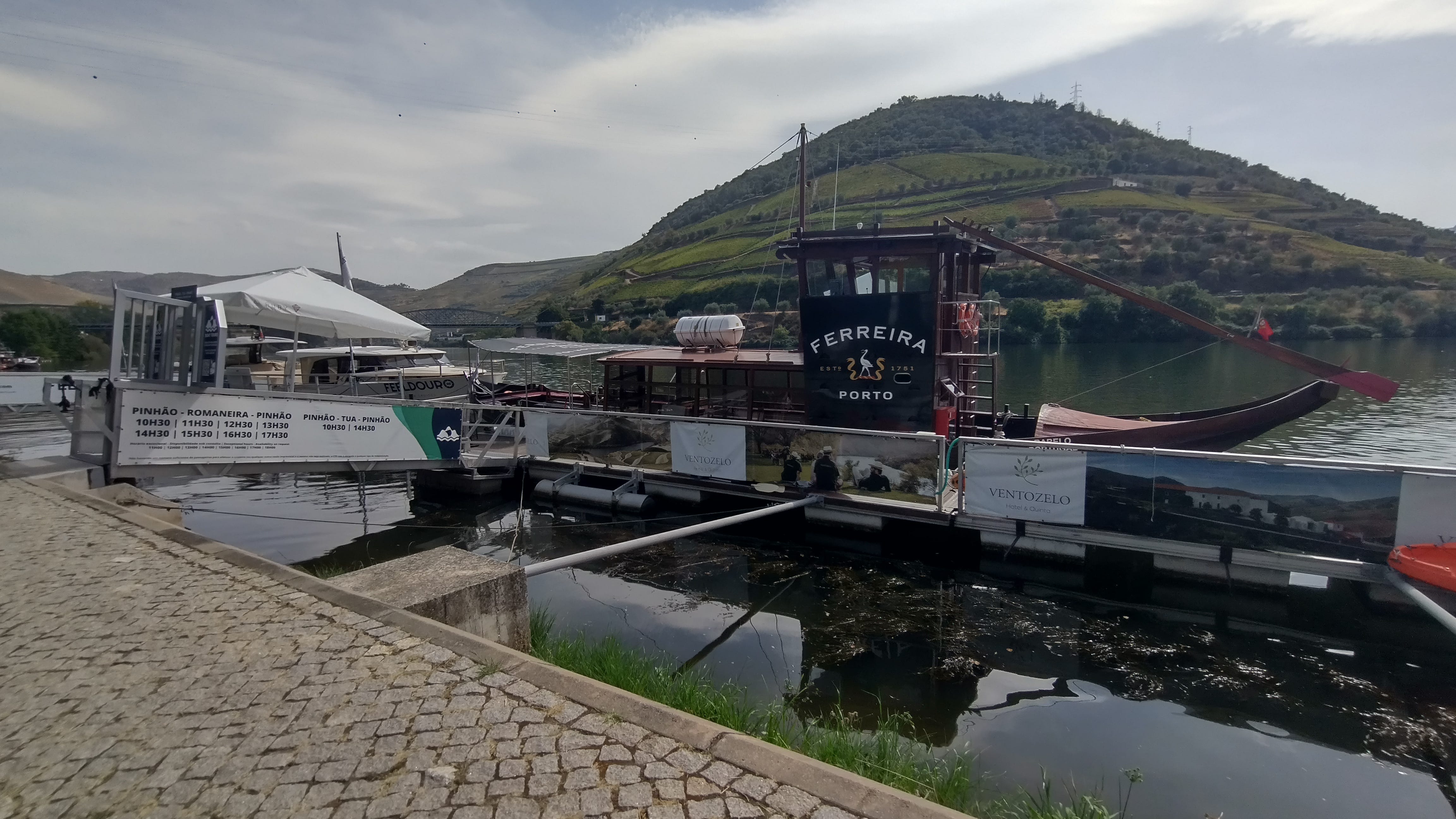
When Paul and I boarded our two-hour rabelo boat in Pinhão, the sun was already warm on the river - one of those brilliant autumn Douro days that make the landscape shimmer. The wooden boat was nearly full, a cheerful mix of travelers from the U.S., France, England and beyond, each looking forward as we were, to see the valley from the water.
As we pushed away from the dock, the hum of conversation gave way to silence. The hillsides rose steeply on both sides, covered with the precise geometry of terraced vineyards. Every curve in the river revealed another beautiful scene: a stone wall, a solitary olive tree, a distant quinta perched like a castle among the vines. It was spectacular!
The rhythm of the water was soothing, and the heat seemed to slow everything to the Douro’s pace, unhurried, reflective, timeless. By the end of the journey, we’d chatted and laughed with our fellow passengers, trading travel stories and tips for local wines. It was more than a cruise - it felt like a floating community, connected by sun, scenery, and the shared joy of the moment.


Cruise Options & What to Expect:
From the Pinhão riverside docks, you can choose from a variety of rabelo experiences:
1-hour scenic cruise: the most popular and accessible, gliding upriver for 20–30 minutes before returning.
2-hour journey to Tua and back: a deeper voyage into quieter, more remote stretches of the river. This is the cruise we chose.
Private or electric rabelo cruises: smaller and quieter, ideal for couples or groups.
Each trip offers panoramic views of the vineyard-clad slopes, historic quintas and sections of the Douro inaccessible by road - a rare chance to see the valley as 19th-century wine shippers once did.
Some cruises include audio commentary about the valley’s geology and winemaking traditions, while others offer tastings of local Port or table wine on board. Our cruise had both audio and Port tastings.
Here’s a short video of our rabelo boat cruise.
Suitability & Accessibility.
Boarding a rabelo involves a few steps and narrow gangways, so full wheelchair access is limited. However, most boats are stable, with gentle movement, and suitable for travelers who can manage moderate steps.
If mobility is a concern, it’s best to call ahead and confirm accessibility with the operator, especially during busy summer months when docking areas can be crowded.
How to Book a Rabelo Tour.
Magnífico Douro - offers both 1-hour and 2-hour departures with audio guide. You can also request private tours.
Living Tours - their 1-hour Rabelo cruise departs from Pinhão’s pier.
Viator – offers 1-hour Rabelo cruise includes an audio guide. Departs from Pinhão’s pier.
GetYourGuide - offers 2-hour tour includes a Port tasting and audio guide. This is the tour we booked.
If You Visit:
Booking & Timing
Cruises operate daily from April through October, with shorter rides offered hourly and longer ones typically mid-morning or mid-afternoon.
The Pinhão docks (“Cais”) are easy to reach by foot from the train station or nearby hotels. Street car parking in the town is limited.
Reserve ahead in peak season to secure seats, especially for the longer 2-hour cruises.
Practical Tips
Arrive 10–15 minutes early for boarding.
Bring a hat, sunscreen, and water. The Douro sun can be intense, even in early autumn.
Light layers help; the temperature can drop slightly when the boat turns into the wind.
If you’re bringing young children along, be sure to always keep an eye on them. Although there are life preservers on board, the boat is low in the water and accidents can happen.
Keep your camera ready, the perspective from the water is entirely different from what you’ll see on the road or on the historic Douro train.
Combine your cruise with a visit to a nearby quinta for a tasting or vineyard lunch afterward. We enjoyed refreshing Port Tonics (white Port and tonic water over ice) and a cured meats and cheese plate at a Quinta do Noval Wine Shop and Tasting Room in town up from the docks.


A rabelo cruise is more than a scenic diversion, it’s a link to the past. Floating where the old wine boats once braved rapids and rocks, you glimpse the valley’s soul from the perspective that made it famous. Whether your day is calm and sunny, as ours was, or moody with mist on the hills, the Douro always feels timeless from the water, a journey back through history, carried by the slow rhythm of the river itself.
P.S. If you’re new here, or if you’ve only been reading OPJ from your inbox, you can always visit Start Here & Explore to browse the publication by topic.
Thanks for being on this journey with me.
Thank you for reading Our Portugal Journey. This publication is free and open to everyone, and it exists thanks to the support of readers like you. If you’d like to receive new posts and help keep this work independent - and help support the research, time and travel that goes into it - you’re warmly invited to become a free or paid subscriber.
You can also buy me a coffee (or a glass of wine) anytime right here.
However you choose to support me, I’m truly grateful you’re here.
Until next time… Obrigada!
Carol
Thanks so much, Teresa! I read a lot about the dangers on the river as I was researching the novel (which is, in fact, called 'O Rapaz do Douro' in Portuguese). How one writer described it before the dams were built still sticks with me: 'Deep down dwells the Fury, which feeds on human blood; and the river prepares it a big harvest.' And of course the British wine trader and artist Baron Forrester -- whose life was ultimately taken by the river -- drew a magnificent map in the 1800s showing 210 'pontos' where the Douro became especially dangerous due to rapids, shallows, fisheries and more. As Carol says, we who travel the river now need a lot of imagination to envisage how it used to be.
This really captures the atmosphere of the Douro today. What’s interesting, though, is how recent the older river world still feels locally, before the dams changed everything. My husband had patients who had worked on the river, and they spoke about it as dangerous, skilled work, where accidents were not uncommon, and people sometimes died.
A friend of mine has actually written a novel set in that earlier period, The Filigree Master’s Apprentice by Jeannine Johnson Maia, which follows a young man travelling downriver to Porto in the 1870s. It gives a vivid sense of the river as a working, and sometimes dangerous, space rather than the calm landscape we see now.