
From Garage Remotes to Handcuffs
My Adventures in Portuguese Communication.

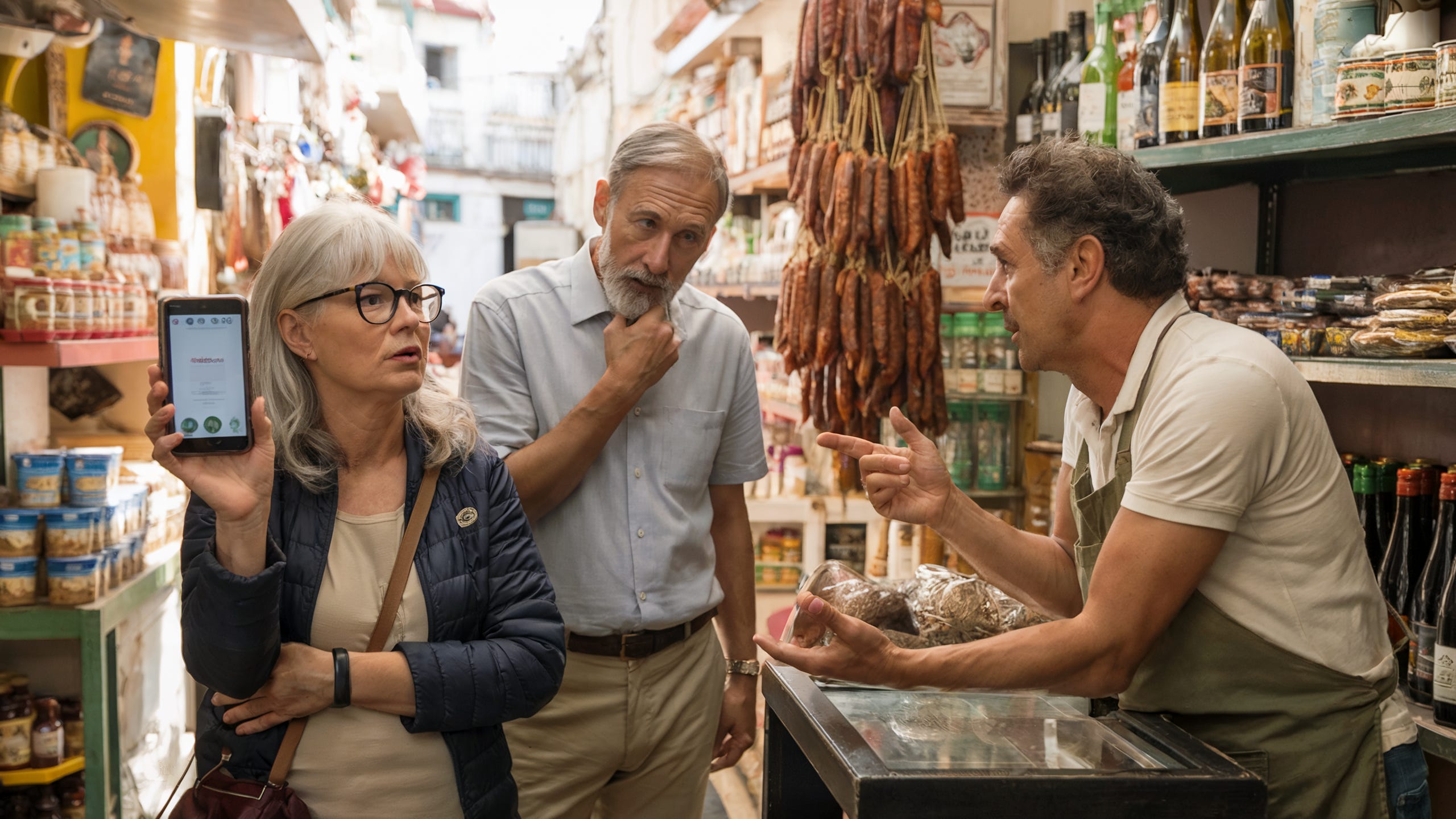
Living in Portugal has taught me many things, but nothing keeps me humble quite like trying to communicate in Portuguese. Some days, my Portuguese comes together well enough to give me confidence. Other days, it reminds me just how far I still have to go.
No matter how many phrases I practice or how often I reach for a translation app, there are still moments when words fail completely, leaving me flustered, embarrassed, or laughing at myself once the moment has passed.
Two recent encounters, one involving a garage door remote and the other an unexpected reference to handcuffs, reminded me just how vulnerable and wonderfully human learning another language can be.
The Locksmith in Cascais
Paul and I recently walked into a small locksmith shop in Cascais to get our remote garage door opener checked (in Portugal, locksmith shops also often repair garage door remotes), because one day - no matter what we tried - it just stopped working. Cascais is a heavily touristed area, and we’ve grown accustomed (or perhaps lazy) to at least some English being spoken. So, politely and with what I thought was decent pronunciation, I asked:
“Fala inglês?”
(Do you speak English?)
The response was immediate and stern.
“No. Only Portuguese.”
No smile. No softening. Just a clear boundary.
We pressed on anyway, holding up the remote and explaining through gestures and limited vocabulary, that it wasn’t working. We were hoping it might simply need a new battery. The clerk disappeared into a back room with our device, and soon returned, speaking rapidly in Portuguese and explaining something technical about the remote - well beyond our language skills and understanding (I was lucky to comprehend every fourth or fifth word).
I pulled out my phone and opened DeepL, hoping translation would bridge the gap. He took my phone and typed his explanation in Portuguese himself. Unfortunately, what came back in English made very little sense. Portuguese doesn’t always translate cleanly, especially when technical details are involved.
That’s when the frustration hit me.
My chest tightened. My hands began to shake. Tears welled up in my eyes - not because of a garage door opener, but because of the exhaustion that comes from frequently having to translate my way through daily life.
The clerk noticed.
“Calma,” he said gently.
Calm.
I took a deep breath.
At that moment, Paul stepped in and somehow pieced together what the clerk was explaining. The remote was simply too old and needed to be replaced. But to program the new one, we would need our landlord’s remote so the two could be paired.
We did exactly that. Borrowed her remote, brought it back, and watched as the clerk worked his magic.
By the end of the exchange, the tension had completely dissolved. We were smiling, talking with our hands and saying lots of obrigadas and obrigados. For a moment, language no longer mattered. We weren’t a frustrated immigrant couple and a stern shopkeeper; we were just three people figuring something out together.
The Tailor and the “Cuffs”
The second incident still makes me smile (sort of).
Paul needed a pair of dress pants altered and wanted to keep the bottom cuffs. The tailor brought him into a tiny dressing room, too small for all of us, so I waited by the counter.
After the measuring and pinning, the woman came over and asked me something in Portuguese. I believed she was asking whether Paul wanted to keep the cuffs at the bottom of the pants.
But just to make sure I understood correctly, and feeling cautious but also rather proud of myself, I pulled out DeepL once again and translated from English to Portuguese:
“Yes, please keep the cuffs on.”
I showed her my phone.
She burst out laughing.
I stared at her, confused.
She held out her wrists to me and laughed again.
And suddenly, it clicked.
Apparently, cuffs do not translate the way I thought they did.
What I had actually asked her to do was to keep the handcuffs on.
Embarrassing? Absolutely.
Hilarious? Without question.
I’m quite sure I made her day and I suspect this story made its way home with her that evening, shared over dinner with family or friends. “You won’t believe what this American woman said today…”
Learning, One Misstep at a Time
Moments like these can feel uncomfortable and sometimes even overwhelming while they’re happening. But with a little distance, they become reminders that learning a new language isn’t just about grammar and vocabulary. It’s about vulnerability. It’s about patience. And it’s about being willing to show up, mistakes and all.
Every misunderstanding teaches me something. Every awkward exchange nudges me forward. And sometimes, what begins in frustration ends in laughter, kindness, and unexpected connection.
And maybe that’s the real lesson. Language doesn’t always have to be perfect to bring people together.
So, now I’m curious
Have you experienced any embarrassing or funny language moments? I’d love for you to share them in the comments so we can laugh, learn, and remind each other that none of us is alone on this journey.
Thanks for being on this journey with me.
Thank you for reading Our Portugal Journey. This publication is free and open to everyone, and it exists thanks to the support of readers like you. If you’d like to receive new posts and help keep this work independent - and help support the research, time and travel that goes into it - you’re warmly invited to become a free or paid subscriber.
You can also buy me a coffee (or a glass of wine) anytime right here.
However you choose to support me, I’m truly grateful you’re here.
Until next time… Obrigada!
Carol
Those are both such great stories! And since you asked for embarrassing or funny language stories, here’s one. I did a study abroad semester in Spain, some 40 years ago. My roommate and I lived with a family in Salamanca. One very hot day we came home from school and the father of the family asked how we were. My American roommate said “soy muy caliente” which translates to “I am very hot” but like hot for a romantic partner! 🤭The father laughed and corrected her, “tengo calor” which translates to I’m hot ( because it’s hot out). She went red in the face when she realized her mistake and blurted out, “¡Estoy muy embarazada!” Which does NOT mean I am very embarrassed, it means, I am very pregnant! 🫣🤣 Thank you for the opportunity to share this story.
So vital to laugh at ourselves when we're learning!
I'm completely fluent now, but my bilingual daughters would often get embarrased at things I said. One day, at a family gathering (my husband is Portuguese), instead of saying "vou dar um beijinho ao Tio" (I'm going to give a little kiss to uncle) I said "Vou beijar o Tio" (I'm going to kiss uncle). I thought it was the same, but it actually implies I was going to snog the uncle... My daughter just said "Oh mum! No!" and hid her head in shame...
And don't get me started on the difference between cocó and coco (poop and coconut) or mispronouncing cozinha (kitchen) as cuzinha (little arse)... there's plenty of these.