
Learning Portuguese: The Starts, the Stops, and What Happens in Between
Why fluency rarely comes all at once, and how many of us quietly find our way into the language over time.

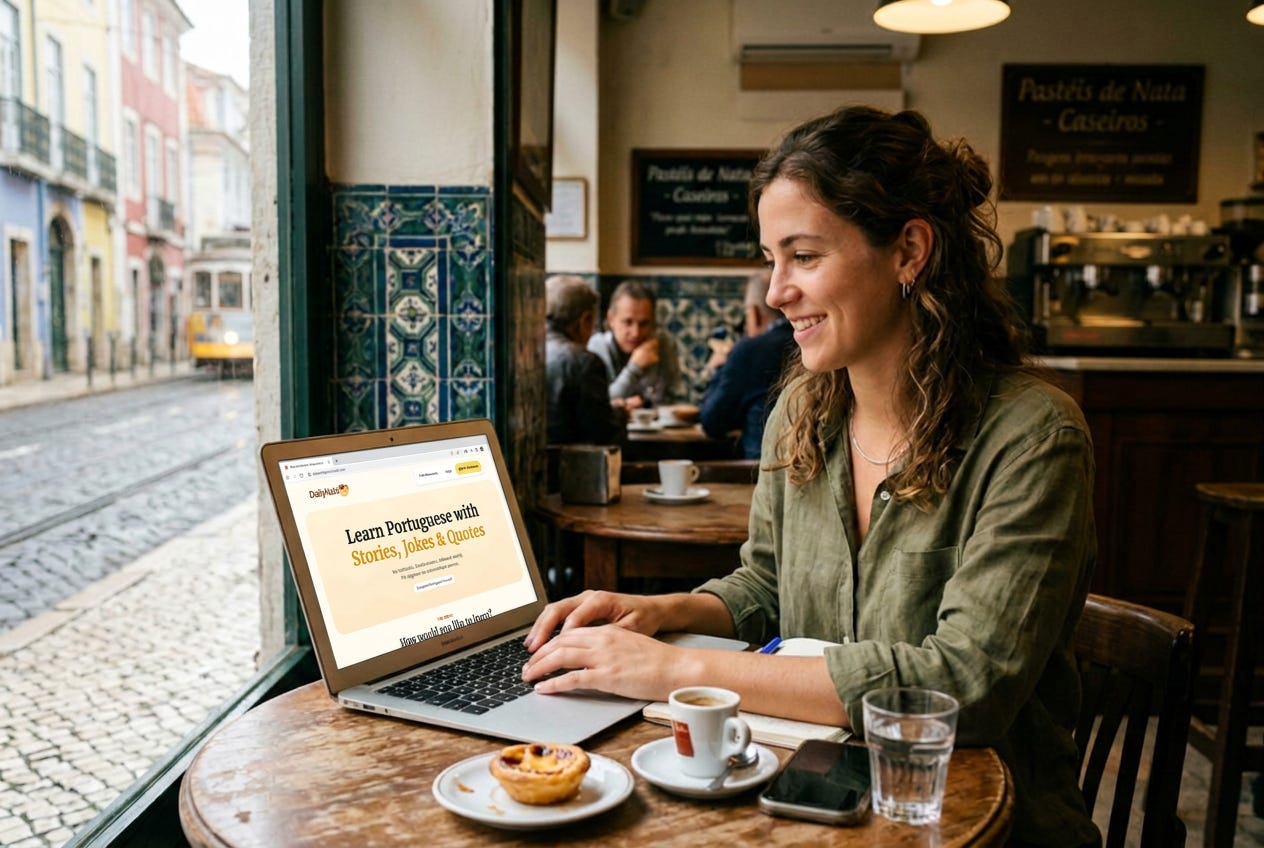
For many people who move to Portugal, or begin planning a visit or longer stay, learning the language quickly becomes part of the conversation.
In cafés, in shops, in small exchanges that happen throughout the day, there is a quiet awareness of what is understood … and what is not.
And for many of us, Paul and I included, learning Portuguese doesn’t happen in the way we might expect. It comes in fits and starts, through small victories, long pauses, moments of embarrassment, and occasional breakthroughs. More often than not, progress is measured over months and years rather than weeks.
Editor’s note: This post is sponsored by DailyNata. I received complimentary access to the platform, but all opinions expressed here—positive or negative—are entirely my own.
The Expectation and the Reality
Before moving to or visiting Portugal, it’s easy to imagine a path.
You take a few lessons. You study consistently. You download a “cheat sheet” of the most commonly used phrases. You build a foundation and, over time, expect that fluency follows.
Paul and I started that way.
We worked with an online tutor before we arrived, trying to prepare ourselves for what was ahead. But like many things that happen in transition, life intervened. There was too much to do, too much to organize, and not enough space to focus.
We tried again shortly after we arrived.
But living here—really living here—requires attention in other ways. Setting up a home. Navigating systems. Establishing routines. The language is all around you, but the time and energy to study it in a structured way can be difficult to sustain.
Over time, I began to realize that we weren’t alone in this.
Many people I’ve spoken to have had similar experiences. Some enroll in intensive classes, only to find the focus leans heavily toward grammar rather than conversation. Some hire private tutors or enroll in immersive language courses, often an expensive option. Others turn to popular language apps, hoping to build consistency, but struggle to stay engaged.
Most of us, in one way or another, learn Portuguese in fragments.
A phrase overheard. A conversation attempted. A word that finally makes sense after hearing it enough times.
Progress happens, but rarely in a straight line.
The Space Between Knowing and Not Knowing
There is also something else that comes with learning a language, especially later in life.
A certain hesitation.
You are asked if you speak Portuguese, and the answer is often, “We’re trying.” Personally, I often find myself saying, “Mais ou menos” (more or less)—one of the few phrases that has stayed with me over the years from my college days.
You understand more than you can say. You piece together sentences. And sometimes, you get it wrong.
It can feel uncomfortable. Embarrassing at times. And yes, discouraging.
And yet, something shifts.
You begin to recognize patterns. You hear familiar sounds. A phrase lands a little more clearly than it did before.
Not fluency, but movement.
Staying Connected to the Language
If there’s one thing I’ve come to understand, it’s that learning Portuguese isn’t always about finding the perfect system.
It’s about finding a way to stay connected to the language consistently, without turning it into another obligation.
Recently, I’ve been exploring a platform called DailyNata, which approaches language learning in a slightly different way. One thing that sets it apart from many online language tools is its exclusive focus on European Portuguese, which can still be surprisingly difficult to find.
Instead of structured classes or rigid schedules, it offers short, weekly lessons built around real phrases and everyday situations—small enough to take in without feeling overwhelming but grounded in how European Portuguese is actually spoken.
How It Works in Practice
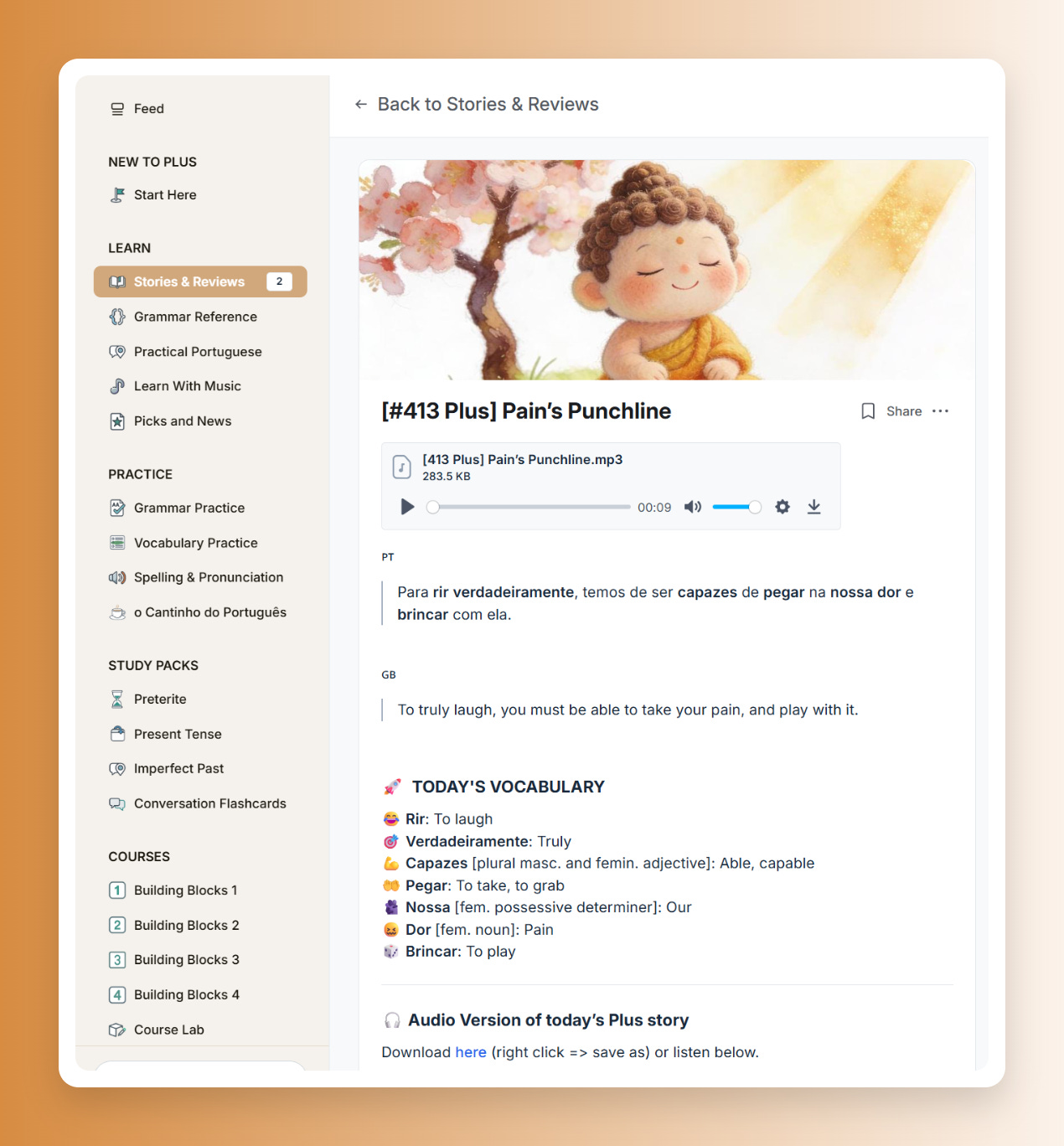
At its simplest, DailyNata begins with a weekly email, often a short quote, story, joke, or phrase—something you can read and listen to in just a few minutes.
The free weekly email serves as the entry point and feels especially approachable for beginners who want to start building familiarity with European Portuguese without immediately committing to a subscription.
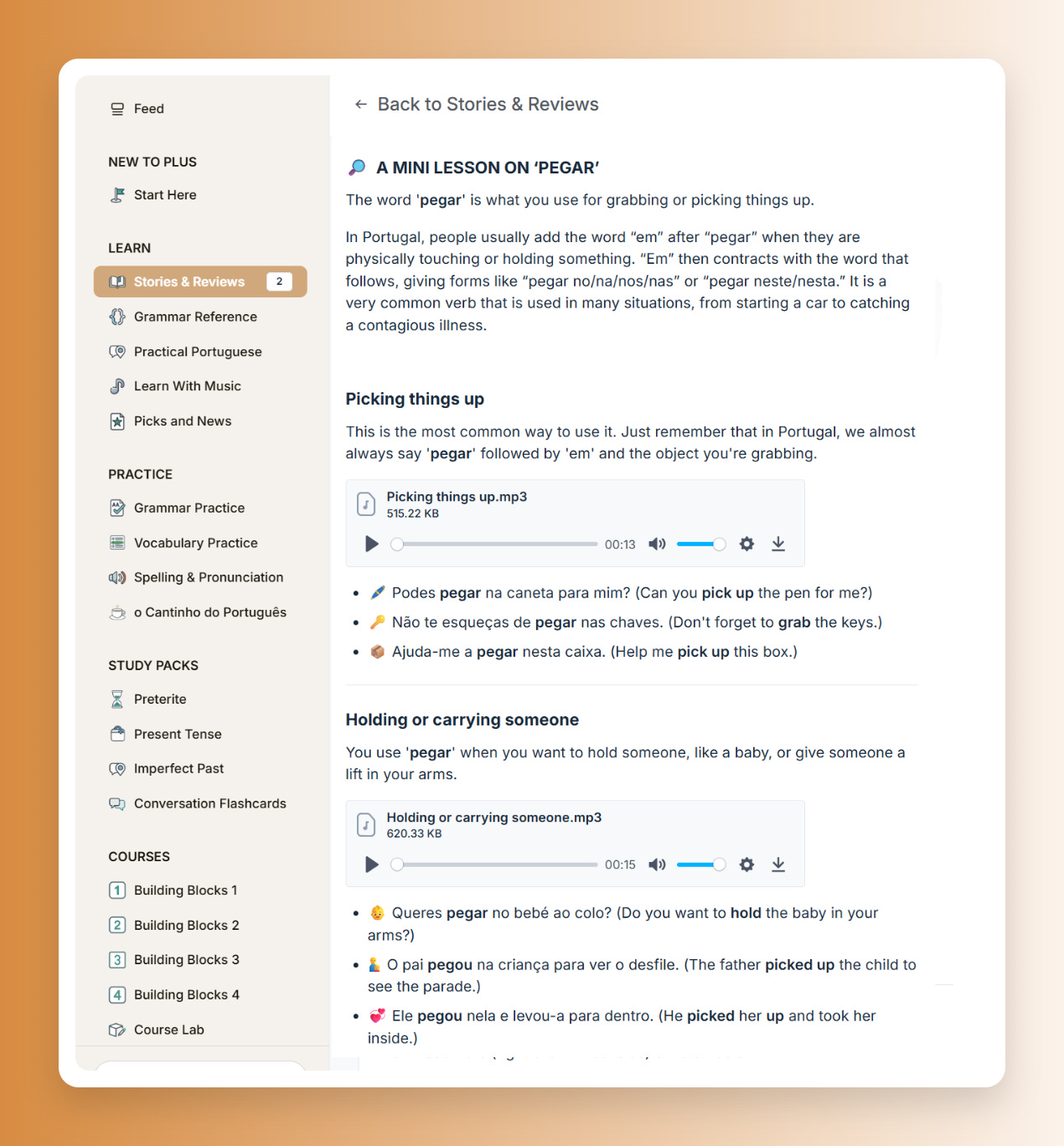
For those who want to go further, the Plus version expands on each lesson with audio, pronunciation guidance, and interactive exercises. There are also weekly challenges tied to the lessons, where members can submit responses and receive thoughtful feedback from a tutor. Members can also ask questions directly within the lesson comments, where the tutor responds personally.
As I spent time with both the free and Plus versions, what stood out most was not just the structure, but how it felt to use.
I didn’t feel the same kind of pressure or intimidation that can come with a classroom or tutor setting. The lessons were engaging and, at times, challenging, but never overwhelming. It felt possible to work through them at my own pace, to pause, and to return when I was ready.
There were also small details that felt particularly useful. Some lessons highlight how phrases are actually said by locals—the kind of phrasing you begin to recognize when you’re out in a café, at a grocery store, or listening to conversations around you. The audio versions can be downloaded and revisited later, making it easy to listen again while walking or going about your day.
DailyNata was created by Amin, a foreigner who moved to Porto and wanted to learn European Portuguese himself. Over time, he found that many language tools either lost his attention or didn’t quite reflect how Portuguese is actually spoken in everyday life. What worked better for him was learning through stories, jokes, quotes, and regular exposure to the language, which eventually became the foundation for DailyNata.
The platform continues to evolve, with many features shaped by feedback from members, which suggests the developers are receptive to the customer experience. DailyNata has also been quietly building a small but steady learning community for nearly four years now.
There is a step-by-step onboarding section to help you get started, which I felt was extremely useful to review, along with a growing library of stories, grammar references, and practical language examples that span early to intermediate levels (roughly A1–B2), depending on the section and lesson type.
But what stood out most for me was the flexibility.
The approach seems rooted in regular exposure rather than intensive study, which may be one reason it feels easier to return to over time.
At one point, Paul listened to a few of the stories and remarked that it felt like something he could return to at his own pace, which in many ways is the challenge for both of us.
You can spend a few minutes reading and listening, or take more time to work through exercises and engage with the community. The pace is entirely your own.
What This Is and What It Isn’t
It’s important to say that this approach isn’t for everyone.
Like any form of language learning, it requires some consistency. It’s not something you absorb passively, but something you return to, in small ways, over time.
It’s also not designed to replace formal study if your goal is certification for permanent residency or citizenship, where more structured coursework is usually necessary. But I can see how it could work alongside that kind of preparation as a way to stay connected to the language between classes or study sessions.
But for many people, that isn’t where the challenge lies.
The challenge is staying engaged long enough for the language to begin to take hold.
And for those who find themselves somewhere in between—living here, planning to live here, visiting, or simply trying to build confidence, this kind of approach may feel more aligned with how life actually unfolds.
If You’re Learning Portuguese
There is no single “right” way to learn.
Consistency often matters more than intensity.
Real-life exposure plays a larger role than expected.
It’s okay for progress to feel slow or uneven.
Finding an approach you can return to matters more than finding the “perfect” one.
Final Thoughts
If there is one thing I’ve come to appreciate over the past several years living in Portugal, it’s that language reveals itself slowly.
Not all at once. Not on a schedule. But in moments.
A conversation that goes a little more smoothly. A phrase that makes sense. A small moment of recognition.
And perhaps that is how many of us find our way into Portuguese—not by mastering it all at once, but by staying close to it long enough for it to begin to feel familiar.
If you’re curious, I’ve included a link button below to explore DailyNata further:
Until next time…
Obrigada!
Carol.
Yes to this! I’m married to a Portuguese from the Açores so it feels like I’m learning two languages most days. The struggle is real and continues on, and yet … there are those magical days when a word or a phrase connects and a feeling of amazement hits, then it’s back to reality.
I really appreciate all of this Carol!