

Recently, I found myself talking with a new acquaintance who now lives full-time in Portugal. Although she and her husband have settled happily into their new life here, they still have a home in the United States filled with the possessions they accumulated over a lifetime.
Like so many people who move abroad, or simply reach a new chapter in life, they now face a difficult question: what do you keep, what do you sell, and what do you let go? It wasn’t the furniture or household goods that troubled her most. It was the things that carried memories.
Her story stayed with me because I recognized exactly what she was feeling.
For Paul and me, letting go of our possessions didn’t happen all at once. It unfolded over many years. When we moved from Rhode Island to Arizona, we left behind many of the antiques that had furnished our homes. Years later, when we sold our Arizona home, to move to Portugal, we faced another round of decisions. Once again, we had to decide what would make the journey with us and what would remain behind.
I’ve known people who have shipped nearly everything they own when they move abroad. Others have arrived with little more than a few suitcases. And some, like Paul and I, ship only what one pallet will hold. There is no right or wrong approach because every life is different, and every home tells its own story.
Some of the things Paul and I let go of were simply possessions. Others carried memories that couldn’t be measured by what they were worth. Even now, I sometimes wonder where some of those things ended up. Is someone listening to one of Paul’s old vinyl records from the 1960s? Did one of our books find its way onto another family’s bookshelf? Are Paul’s antique license plates hanging in someone’s garage? Does a framed New England watercolor that once hung on our wall now hang in another home? Are my Norman Rockwell Four Seasons commemorative plates displayed in someone else’s kitchen?
Perhaps if we knew where the things we let go of ended up, we might not feel such a profound sense of loss.
For me, one item has a story I do know.
Like many brides-to-be of the 1970s and 80s, I registered for wedding gifts before Paul and I were married. My mother and I spent an afternoon at Tilden-Thurber in downtown Providence, Rhode Island, at the time one of the state’s oldest and most respected jewelers and retailers of fine china and crystal. For generations, brides had walked through its doors to choose the patterns they hoped would grace their future homes.
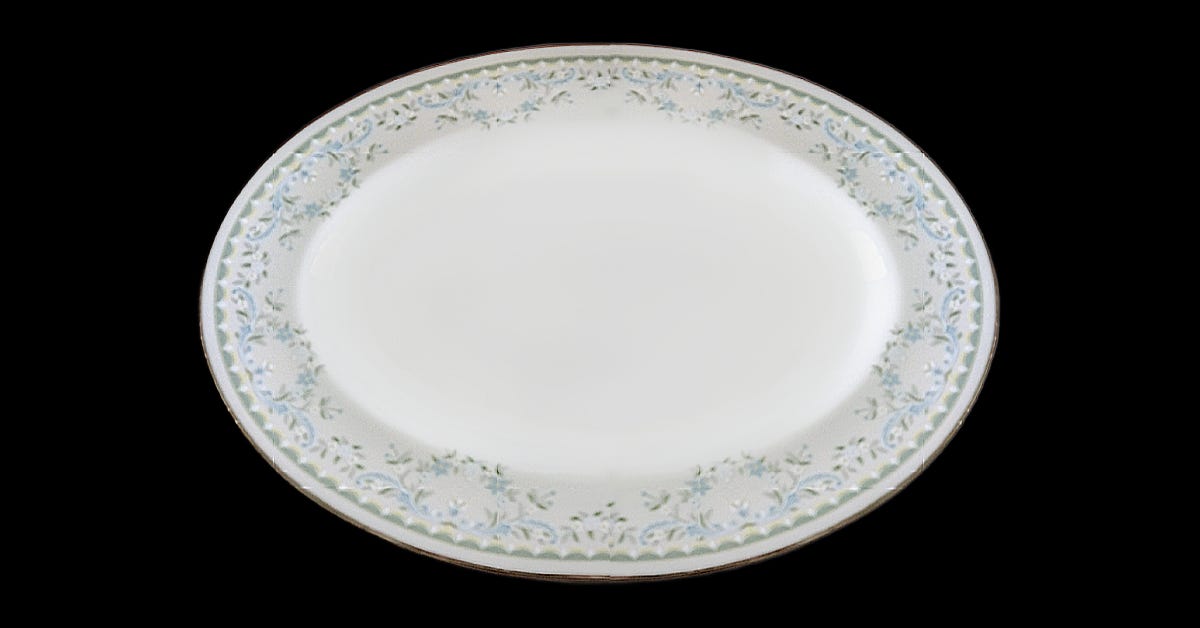
The china I selected was made by Pickard, and the pattern was called Tara. It had a warm cream-colored background accented with blue-gray scrollwork, vivid blue and white flowers, a soft green border, and platinum trim. Even then, it was expensive, and I remember feeling both excited and slightly overwhelmed as my mother and I made our selections.
Our family and friends were generous. Over the weeks surrounding our wedding, beautifully wrapped packages began arriving, each containing another piece of the china I had chosen. By the time the gifts had all been opened, we had nearly enough for about five place settings including cups, saucers, and a serving platter - enough pieces to begin with and add to later.
Although Paul and I rarely used the china, I could never imagine parting with it. It reminded me of those days with my mother, of opening wedding gifts, and of the excitement that comes with beginning a new chapter in life. It wasn’t simply a collection of dishes. It represented memories that could never be replaced.
Over the years, however, my tastes changed. I found myself drawn to simpler white dinnerware that could be accentuated with colorful placemats or linens. The Tara pattern was still beautiful, but it belonged to another era. Production of the pattern ended in 1994, and by then wedding registries had changed as well. Couples were more likely to register for experiences, honeymoon funds, or contributions toward a first home than for formal china that might spend most of its life in a cabinet.
When it came time to prepare for our move to Portugal, I knew the china would not be making the trip. So I decided to photograph a few pieces, wrote descriptions of them, explaining that they had been part of my wedding china and had been rarely used, and then listed them on Etsy. I only listed a small portion of the collection because, truthfully, I wasn’t sure anyone would want long ago discontinued pieces from an incomplete set. Or perhaps I also wasn’t entirely ready to let them go.
But to my surprise, they sold almost immediately.
Not long after the first pieces sold and I had shipped them, I received a message from the woman who had purchased them. She shared a story I never could have imagined:
As a senior in a Midwestern high school in 1980, she had won an essay contest, and the prize had been a single place setting of Pickard china in the Tara pattern. She loved it, but she could never afford to add to the collection. By the time she was finally in a position to do so, the pattern had already been discontinued. Over the years she searched estate sales, and online marketplaces whenever she could, slowly building her collection one piece at a time.
When she found my listing, she already had accumulated four complete place settings and was working towards obtaining at least four more. She asked if I happened to have any additional pieces.
I did.
I listed almost everything that remained, keeping only one dinner plate and the serving platter for sentimental reasons. She purchased every piece I offered. As I packed the second shipment, I discovered one more matching cup and saucer tucked away in the cupboard. I wrapped it carefully and included it in the box as a surprise.
During our correspondence, I explained why I was selling my wedding china. We were moving to Portugal, and I simply couldn’t bring everything with us. She thanked me for listing them for sale, and told me the china would be used, loved, and enjoyed at family gatherings for years to come. She promised she would be a good steward of the pieces and later sent me a photograph of my wedding china displayed in her dining room china cabinet. Seeing those familiar pieces enjoyed in another home somehow made it easier to let them go.
Whenever I find myself wondering where some of our things went, I think about that china. It reminds me that the objects we part with do not simply disappear. Sometimes they become part of another family’s celebrations, another holiday table, or another generation’s memories.
I still have the serving platter and one dinner plate. Every now and then, when friends gather around our table in Portugal, I use them to serve desserts or appetizers.
And somewhere in the American Midwest, I like to think the rest of our china has found its place around another family table, where it continues to be used, loved, and enjoyed as new memories are made.
Thanks for being on this journey with me.
Thank you for reading Our Portugal Journey. This publication is free and open to everyone, and it exists thanks to the support of readers like you.
If this work resonates with you, you’re warmly invited to subscribe - or, if you’d like, to support it as a paid subscriber and help keep it independent.
You can also buy me a coffee (or a glass of wine) anytime right here.
However you choose to support this work, I’m truly grateful you’re here.
Until next time…
Obrigada!
Carol.
That's a lovely story Carol and so well written! I understand completely how you feel. I'm going through this right now with my wedding dress. I know it will not come with me, it's an emotional thing. Your perspective will help me find a loving home for it now. Thank you.
Beauifully written Carol. The more you write the better you get. I'm sure your story will help those considering a big move. Xoxo to you and Paul.