
Inside Portugal’s Government: A High-Level Guide for Foreign Residents and Curious Readers [Bonus Post]
Understanding how the Portuguese government is structured, how it functions, and the political parties that shape it.

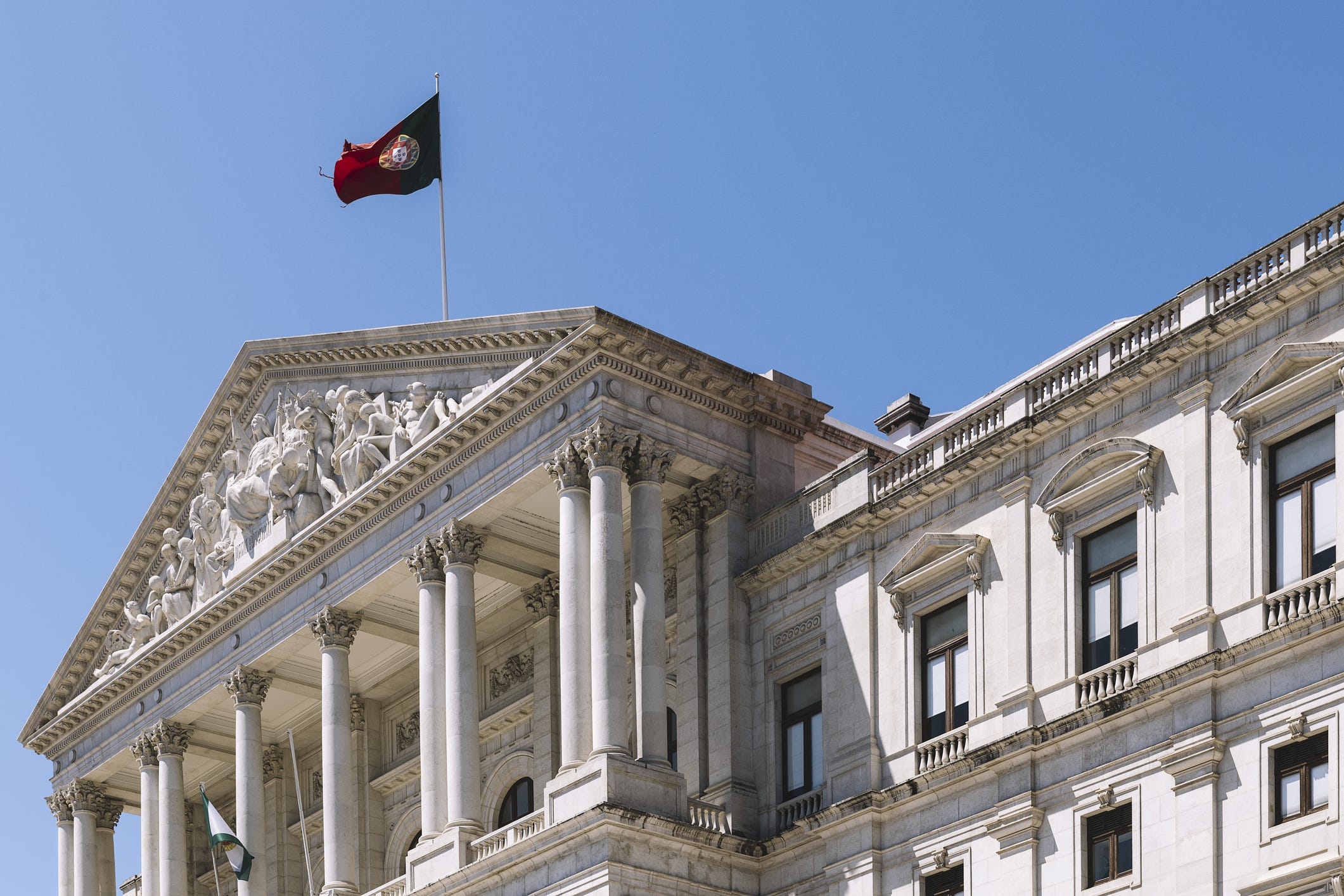
For many foreign residents, Portugal’s political system can feel unfamiliar at first. The country has both a President and a Prime Minister, a multi-party parliamentary system, and institutions that often differ from those in other democracies. This guide offers a clear, high-level overview of how Portugal’s government is structured and how it functions today.
When Paul and I moved to Portugal, I quickly realized how little I understood about the country’s civic framework. I recognized campaign billboards along the roads and knew Portugal was a democratic republic, but beyond that my understanding was limited.
Perhaps other foreign residents arrive with a deeper knowledge of Portuguese politics. But if you’re anything like I was—living here, considering a move, or simply curious—you may appreciate a structured introduction to how the government works and the major political parties that shape it.
This article was originally published two years ago and has been thoroughly updated to reflect current institutions and improve its organization and clarity.
This guide isn’t intended to advocate for any political viewpoint or debate public policy. Its purpose is simply to provide an accessible overview of Portugal’s system of government so readers can better understand the country in which they live, travel, or take an interest. As always, I welcome thoughtful corrections if I’ve overlooked something of educational value.
Portugal as a Democratic Republic
Portugal is officially the Portuguese Republic (República Portuguesa), a democratic state governed under the Constitution of 1976, which was adopted after the Carnation Revolution of 1974 ended decades of authoritarian rule.
Portugal operates under a semi-presidential system. This means executive authority is shared between a President and a Prime Minister. Unlike purely presidential systems, power is distributed across institutions that balance one another.
Understanding that shared structure is key to understanding how Portugal governs.
The Executive Branch
The executive branch includes both the President of the Republic and the Government.
The President of the Republic serves as head of state and is elected directly by the people by popular vote for a five-year term (with a two-term limit). The President’s constitutional powers include:
• Appointing the Prime Minister based on parliamentary election results
• Dissolving Parliament under certain conditions
• Vetoing legislation (subject to parliamentary override)
• Serving as Commander-in-Chief of the Armed Forces
• Acting as a constitutional guardian and stabilizing authority
While the President has meaningful powers, the daily administration of the country is carried out by the Government.
The Government is led by the Prime Minister, who is typically the leader of the party (or coalition) that holds a majority in Parliament. The Prime Minister works with the Council of Ministers.
The Government is responsible for:
• Proposing legislation
• Implementing and enforcing laws
• Managing public administration
• Directing domestic and foreign policy
• Overseeing public services such as healthcare, education, and infrastructure
The Legislative Branch
Portugal’s legislative body is the Assembleia da República (Assembly of the Republic).
It consists of 230 deputies elected through proportional representation for four-year terms.
The Assembly’s responsibilities include:
• Drafting and passing legislation
• Approving the state budget
• Supervising and holding the Government accountable
• Ratifying international treaties
• Proposing constitutional amendments
Because Portugal uses proportional representation, multiple political parties are typically represented in Parliament. Coalition governments are common.
How the Pieces Fit Together
For readers coming from a presidential system like that of the United States, the most confusing aspect of Portugal’s government is understanding how the President, Parliament, and Prime Minister relate to one another.
A simplified way to visualize it is this:
The President serves as head of state and constitutional guardian.
The Parliament creates laws and oversees the Government.
The Prime Minister leads the Government and executes policy.
Authority is shared and balanced across these roles rather than concentrated in a single office.
The Judicial Branch
Portugal’s judicial system operates independently from the executive and legislative branches.
The court system includes:
• The Constitutional Court, which reviews the constitutionality of laws
• The Supreme Court of Justice
• Administrative and fiscal courts
• Lower courts of first instance
Judicial independence is protected under the Constitution and forms an essential part of Portugal’s democratic framework.
Autonomous Regions and Local Government
Portugal includes two autonomous regions:
• The Azores
• Madeira
Each region has its own regional government and legislative assembly with certain self-governing powers.
On the mainland, local governance is organized through:
• Municipalities (Municípios)
• Civil Parishes (Freguesias)
Municipal governments are responsible for local infrastructure, urban planning, public services, and community-level administration.
Major Political Parties in Portugal
Portugal has a multi-party system. Among the most significant parties in recent years are:
Socialist Party (PS – Partido Socialista)
A center-left party advocating social democracy, public services, and welfare-state policies.
Social Democratic Party (PSD – Partido Social Democrata)
A center-right party (despite its name) supporting market-oriented policies, economic liberalism, and moderate conservatism.
Chega (In Portuguese, this means “Enough”)
A right-wing populist party advocating stricter immigration policies, law-and-order initiatives, and institutional reform.
Liberal Initiative (IL – Iniciativa Liberal)
A classical liberal party supporting free markets, tax reduction, and reduced state intervention.
Left Bloc (BE – Bloco de Esquerda)
A left-wing party supporting labor protections, social justice initiatives, and progressive social policies.
Portuguese Communist Party (PCP)
A left-wing party with historical roots in anti-dictatorship resistance, advocating worker protections and strong public-sector involvement.
Other smaller parties and coalitions also participate in elections, and political dynamics continue to evolve.
Why Civic Understanding Matters
Understanding the structure of Portugal’s government is not about partisanship. It is about civic literacy.
For those living in Portugal, whether temporarily or permanently, knowing how the system works provides context for elections, public policy decisions, and national debates.
It clarifies:
• How leadership roles differ from other democratic systems
• Why coalition-building is often necessary
• How laws move from proposal to implementation
• How regional and local authorities function
Portugal’s democratic framework is shaped by its history, its Constitution, and its multi-party parliamentary tradition. Taking the time to understand that structure is one small but meaningful way to understand the country itself.
Further Reading & Official Resources
For readers who would like to explore Portugal’s government in greater depth, the following official and educational resources provide detailed and up-to-date information:
Official Government Sources
• Assembleia da República (Assembly of the Republic) – Official parliamentary website
• Presidência da República – Office of the President of the Republic
• Governo da República Portuguesa – Official Government portal
• Tribunal Constitucional – Constitutional Court of Portugal
• Comissão Nacional de Eleições – National Election Commission
As with any political structure, institutions evolve, and elections change the composition of Parliament over time. For the most current information, consulting official government websites is always recommended.
Thank you for reading Our Portugal Journey. This publication is free and open to everyone, and it exists thanks to the support of readers like you. If you’d like to receive new posts and help keep this work independent - and help support the research, time and travel that goes into it - you’re warmly invited to become a free or paid subscriber.
You can also buy me a coffee (or a glass of wine) anytime right here.
However you choose to support me, I’m truly grateful you’re here.
Until next time… Obrigada!
Carol
An article related to Portugal’s president:
The Belém Palace, formally called the National Palace of Belém, is the official residence of Portugal’s president and the seat of the nation’s head of state. Its distinctive pink façade faces one of Lisbon’s most ceremonial public spaces. Every third Sunday of the month at 11:00 a.m., the Republican National Guard (GNR – Guarda Nacional Republicana) performs the Ceremony of the Solemn Changing of the Guard directly across from the palace. Lasting about an hour, the event draws visitors and locals alike and is often cited among the top twenty changing-of-the-guard ceremonies in the world.
Thanks for information. I didn’t know about the Changing of the Guards ceremony. We’d like to be in Lisbon when it happens sometime.
Great thoughtful overview Carol. It’s super timely in this fraught geopolitical world. Curious to know US military presence in the country and cooperation or not in support of current worldwide conflicts. Love reading your always insightful articles.