
How Safe Is the Food We Eat in Portugal?
Recent food safety concerns in the United States prompted me to take a closer look at how Portugal protects the food we eat and where consumers can turn for reliable information.

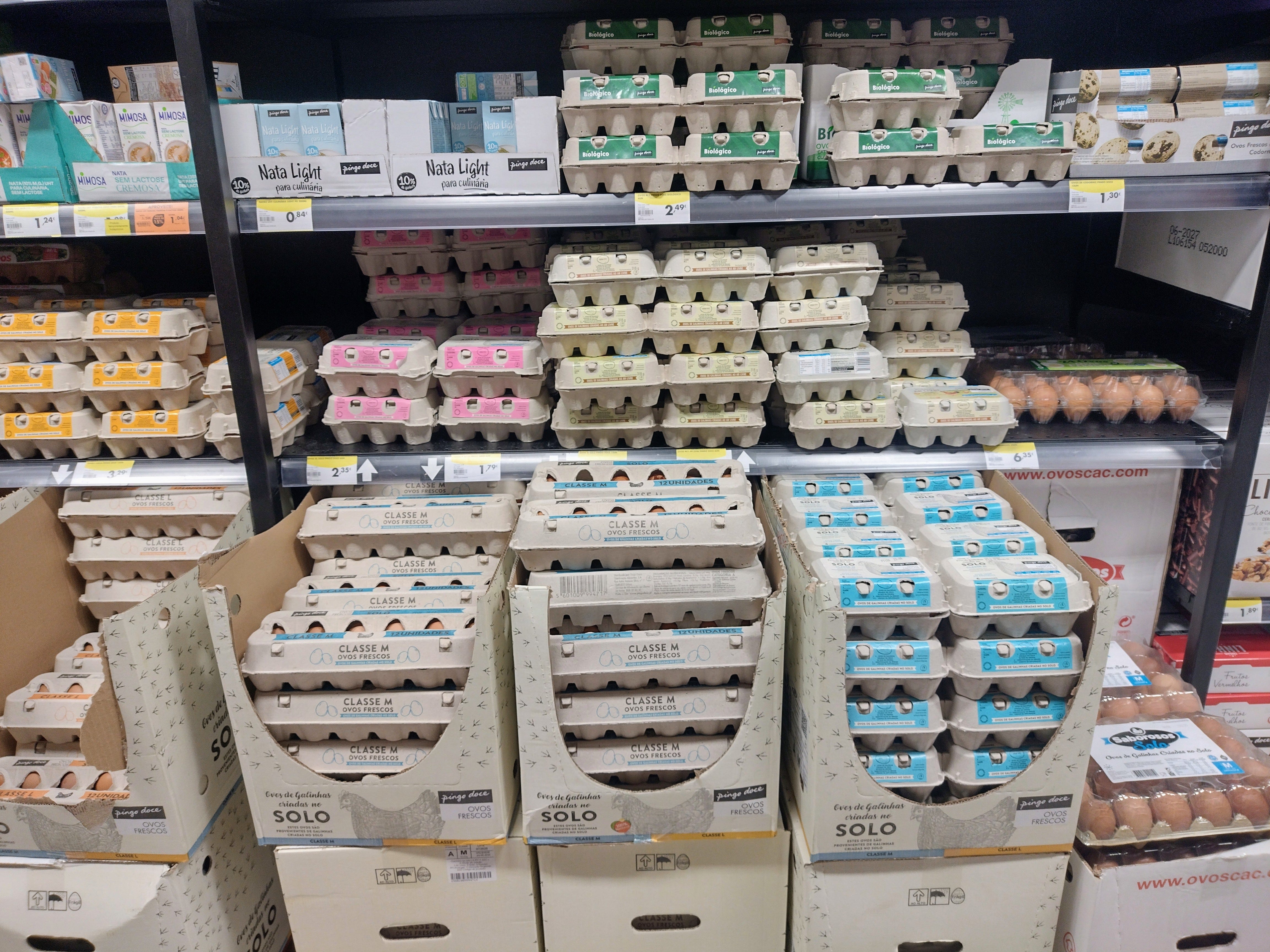
Recent headlines about food recalls and foodborne illnesses in the United States caught my attention. Not because they affected my daily life in Portugal, but because they reminded me of one of the first things that puzzled me after we moved here.
It wasn’t a restaurant inspection or a government announcement. It was a carton of eggs.
Standing in a Portuguese supermarket during our first months here, I remember looking around for eggs in the refrigerated section. After searching in vain, I realized they weren’t there. I found the eggs sitting on an ordinary store shelf, just as they would be in every Portuguese supermarket I visited over the following months.
Having spent my entire life in the United States, I assumed something wasn’t right. After all, Americans are taught from an early age that eggs belong in the refrigerator.
Eventually, I learned there was a perfectly logical explanation. In the United States, commercial eggs are typically washed before they reach grocery stores, a process that can affect the shell’s natural protective coating. U.S. food safety regulations also require untreated shell eggs to be refrigerated during storage and transportation and at retail.
Portugal, like other European Union countries, takes a different approach. Class A eggs generally aren’t washed before sale, which helps preserve the shell’s natural protective cuticle. EU regulations also generally prohibit chilling these eggs below 5°C before sale and require them to be stored and transported under conditions designed to preserve their hygienic properties. That’s why seeing eggs sitting unrefrigerated on a Portuguese supermarket shelf isn’t unusual.
The eggs themselves weren’t “better” or “worse.” They were simply part of a different food safety system. That discovery stayed with me, and I began thinking: if something as familiar as eggs was handled differently here, what else didn’t I understand about food safety in Portugal? Then, after reading about the recent rise in food recalls and foodborne illnesses in the United States, I found myself returning to a larger question: how confident should I feel about the food Paul and I eat every day in Portugal?
What I expected to be a quick article turned into one of the more interesting research projects I’ve undertaken for Our Portugal Journey
I Thought This Would Be a Simple Question
Years before moving to Portugal, Paul and I owned a historic country store with a small deli café in Rhode Island. Food safety wasn’t an abstract concept. It was part of our everyday lives.
Like many small business owners, we occasionally received unannounced visits from state health inspectors. Refrigerators were monitored, food temperatures were checked, sanitation procedures mattered, and employee training was simply part of running the business in a responsible manner.
That’s probably why those unrefrigerated Portuguese eggs caught my attention. I assumed I’d find one official website explaining how Portugal’s food safety system worked.
But instead, every answer seemed to lead me somewhere else.
I found government agencies responsible for different parts of the food chain, researchers studying foodborne illness and consumer behavior, and European institutions providing scientific guidance.
At one point I realized I had more than a dozen browser tabs open on my computer, each explaining another piece of the puzzle. It was only then that I realized I had been asking the wrong question. I wasn’t looking for one answer. I was looking at an entire system.
Seeing the Bigger Picture
One of the biggest surprises wasn’t learning why Portugal stores eggs differently than the United States. It was discovering how differently the two systems are structured.
Because many Our Portugal Journey readers are American (or once were), we naturally view Portugal through the lens of what we’re already familiar with. I know I did.
In the United States, food safety oversight is shared among federal agencies such as the Food and Drug Administration (FDA) and the U.S. Department of Agriculture (USDA), together with state and local health departments that monitor food safety in their respective communities.
Portugal’s national food safety system operates within the European Union framework. Organizations such as ASAE (Autoridade de Segurança Alimentar e Económica), DGAV (Direção-Geral de Alimentação e Veterinária), and INSA (Instituto Nacional de Saúde Doutor Ricardo Jorge) each have distinct responsibilities, while the European Food Safety Authority (EFSA) provides independent scientific advice that helps inform food safety policy across the European Union.
The differences aren’t simply about who oversees the system. Both the United States and the European Union rely on scientific evidence and risk assessment to protect the food supply, although their regulatory frameworks are not identical.
In the United States, the regulatory approach varies depending on the type of food or ingredient and the laws governing it. Some substances, including food additives, generally require FDA review before they can be used, while substances considered Generally Recognized as Safe (GRAS) are treated differently under federal law. The FDA also monitors the safety of foods and ingredients already on the market and can take action when new evidence identifies a safety concern.
The European Union’s food safety framework also relies on scientific risk assessment, but specifically incorporates what is known as the precautionary principle. When there are reasonable grounds for concern about a potential health risk but scientific uncertainty remains, authorities can take protective measures while additional scientific information is gathered.
Neither system is static. Both continue to evolve as science advances, consumer expectations change, and new food safety challenges emerge.
For me, that was an important realization. This wasn’t about deciding which system was better. It was about understanding how they work and why some of their approaches differ. That understanding also changed how I thought about food safety itself.
Before researching this article, I tended to think of food safety through the lens of inspections. Having owned a small food service business in Rhode Island, I knew firsthand that health inspectors periodically visited restaurants, grocery stores, and other food businesses to verify that food was being handled, stored, and prepared safely. Those inspections remain an important part of the system. What I hadn’t fully appreciated was how much of food safety happens long before an inspector ever walks through the door.
It begins on farms and in fisheries, then moves through food processing plants, distribution centers, transportation networks, grocery stores, neighborhood cafés, farmers’ markets, wineries and breweries, village festivals, restaurants, food trucks, and finally, our own kitchens.
As consumers, we see only the very last step in that journey: the groceries in our shopping cart or the meal placed in front of us. Everything that happened before that is largely invisible.
Throughout Portugal and the European Union, food businesses are expected to operate under the principles of Hazard Analysis and Critical Control Points (HACCP), an internationally recognized food safety system designed to identify and prevent potential problems before they occur. Rather than relying solely on inspections to catch problems after the fact, HACCP emphasizes prevention at every stage of the food chain by continually asking one simple question: Where could something go wrong, and how do we prevent it?
Once I understood that philosophy, I stopped thinking of inspections as the beginning of food safety. Instead, I came to see them as one visible checkpoint within a much larger system, one that depends on farmers, producers, manufacturers, distributors, retailers, regulators, researchers, and consumers all doing their part to help keep food safe.
Where I Would Look Today
By the time I understood how the pieces fit together, I had developed a small collection of resources that gave me confidence. They’re the ones I now turn to whenever I have questions about food safety in Portugal.
I eventually found the Portuguese government’s English-language guide to consumer product safety. It didn’t answer every question, but it helped me better understand how Portugal’s consumer safety system is organized and pointed me toward the agencies responsible for different parts of it.
For questions about food safety inspections, enforcement, or reporting a concern, ASAE is where I would begin. DGAV is another important resource, particularly for information involving the food chain, animal health, and food production. INSA, Portugal’s National Institute of Health, provides scientific and public health information, including work related to food and foodborne illness.
At the European level, EFSA provides independent scientific information about food-related risks. Its Safe2Eat campaign is particularly useful for consumers, with practical information about topics such as food hygiene, allergens, foodborne illness, and understanding food labels.
One resource I hadn’t expected to rely on for food safety was Safe Communities Portugal. While it isn’t a government agency, its Facebook page regularly shares English-language summaries of recalls, consumer alerts, and other public safety information that may be particularly useful for foreign residents.
Finally, I realized that significant recalls often become news stories much like they do in the United States. Portugal’s public broadcaster, RTP, and other national news organizations report important food safety developments, often directing readers to the relevant official announcements.
What Changed My Thinking
Living abroad has a way of challenging things we’ve accepted for years without ever questioning them. Sometimes those differences are obvious. Other times they’re sitting quietly on a supermarket shelf.
Food safety turned out to be one of those differences.
What changed wasn’t my awareness of food safety. If anything, I probably pay more attention now than I did before. I still notice whether a restaurant, pastelaria, grocery store, food truck, or other food establishment appears clean and well cared for. I still use common sense when shopping, preparing meals, or eating out. No country has a perfect food safety system, and Portugal is no exception.
What did change was my perspective. I’ve become less interested in asking whether something is different and more interested in asking why. More often than not, there’s a thoughtful explanation waiting to be discovered.
This research didn’t leave me with blind confidence. It left me with something more valuable: a better understanding of how Portugal’s food safety system works and where I can turn when I have questions or concerns.
Looking back at the eggs sitting on the shelf, I smile at how quickly I assumed something must be wrong. In reality, I wasn’t discovering a problem. I was discovering that another country had approached the same food safety challenge in a different way.
I’d Love to Hear from You
Research can only tell us so much. Personal experience often fills in the rest.
Writing this article reminded me that food safety is one of those topics we rarely think about until something surprises us or something goes wrong. I’d love to hear what you’ve observed from your own experiences.
Has anything about food safety in Portugal surprised you, either positively or negatively?
Have you ever experienced a food recall or food safety concern in Portugal?
Is there a trusted food safety resource you use that I haven’t mentioned?
Has living in or visiting Portugal changed the way you think about food safety, grocery shopping, or eating out?
If you’ve worked in food service, hospitality, agriculture, public health, or food safety, I’d especially welcome your perspective. One of the things I value most about this community is the knowledge and experience readers generously share with one another.
Resources for a Deeper Dive
If you’d like to explore further or verify some of the information in this article, I’ve gathered the official resources and additional reading I found most useful below.
If you use a VPN, you may need to turn it off to access some of these resources.
Official Portuguese Resources
Portuguese Government – Consumer Product Safety (English)
General information about Portugal’s consumer product safety system and the authorities responsible for different areas.
ASAE – Autoridade de Segurança Alimentar e Económica
Portugal’s Food and Economic Safety Authority, responsible for inspection and enforcement in areas that include food safety. The website includes a section titled, Public Safety listing any food alerts or recalls. https://www.asae.gov.pt/
ASAE – Complaints and Reporting
For reporting a possible food safety or other matter within ASAE’s jurisdiction.
https://www.asae.gov.pt/espaco-publico/formularios/queixas-e-denuncias.aspx
DGAV – Direção-Geral de Alimentação e Veterinária
Portugal’s Directorate-General for Food and Veterinary, with responsibilities across areas including food production, animal health, plant health, and the food chain.
INSA / PortFIR – Portuguese Food Information Resource
An English-language resource from Portugal’s National Institute of Health Dr. Ricardo Jorge, with information and databases related to food composition, contamination, consumption, nutrition, and food safety.
https://portfir.insa.min-saude.pt/en/
European Union Resources
European Food Safety Authority (EFSA)
The EU’s scientific reference body for assessing risks related to food and feed. (English) https://www.efsa.europa.eu/en
EFSA – Safe2Eat
A consumer-focused campaign offering practical, science-based information about food safety, handling, storage, labels, allergens, and other everyday food questions. (English) https://www.efsa.europa.eu/en/safe2eat
European Union – General Food Law, Regulation (EC) No 178/2002
The foundation of EU food law, including risk analysis and the precautionary principle discussed in this article. See Articles 6 and 7.
https://eur-lex.europa.eu/eli/reg/2002/178/
European Union – Marketing Standards for Eggs, Regulation (EU) 2023/2465
The EU regulation covering Class A eggs, including requirements concerning washing, cleaning, chilling, and storage information.
https://eur-lex.europa.eu/eli/reg_del/2023/2465
Additional Reading and Consumer Resources
U.S. Food and Drug Administration – Shell Egg Safety and Refrigeration
FDA guidance explaining U.S. requirements for safe-handling statements and refrigeration of untreated shell eggs at retail.
Safe Communities Portugal
A public safety resource for residents and visitors. Its Facebook page also shares consumer alerts and food recall information. (Available in multiple languages)
(English) https://www.safecommunitiesportugal.com/
ASAE Information Page - https://www.safecommunitiesportugal.com/find-information/police-in-portugal/asae/
Evaluating the Effectiveness of Food Safety Policies in Portugal
Academic research examining challenges and opportunities within Portugal’s food safety governance system. https://pmc.ncbi.nlm.nih.gov/articles/PMC12071217/
Self-reported Practices by Portuguese Consumers Regarding Eggs’ Safety
Research examining how Portuguese consumers buy, store, handle, and prepare eggs, including practices that may affect food safety.
SafeConsume Summary - https://safeconsume.eu/articles/new-study-on-handling-eggs-unsafely-in-portugal-how-to-change-consumer-practices
Original Journal Article - https://doi.org/10.1016/j.foodcont.2021.108635
Food Safety News – Cheese Linked to Salmonella Outbreak in Portugal
A recent example of a foodborne illness investigation and product recall in Portugal. Food Safety News also offers free email alerts for readers who want to stay informed about food safety developments.
https://www.foodsafetynews.com/2026/07/cheese-linked-to-salmonella-outbreak-in-portugal/
RTP Notícias
Portugal’s public-service broadcaster and a useful source for significant national news, including major consumer and food safety developments. https://www.rtp.pt/noticias/
Thanks for being on this journey with me.
Our Portugal Journey is free and open to everyone. If you enjoy the stories I share and would like to help support the work that goes into them, you can do so in either of these ways:
Thank you for reading and for being part of Our Portugal Journey.
Until next time…
Obrigada!
Carol.
Loving that you wrote this 🥰
Thanks for the deep dive ! Interesting article.